





18 Feb Interview with HATEDEMICS project
1. What is the HATEDEMICS project seeking to achieve?
The HATEDEMICS project seeks to address the intersection of online hate speech and disinformation by strengthening prevention, detection, and response mechanisms across the EU. It aims to empower civil society organisations, public authorities, fact-checkers, and young people through a combination of technological tools, training, and awareness-raising activities. Central to the project is the development of an AI-based platform to monitor harmful content, assess risk, and support the creation of effective counter-narratives using a human-in-the-loop approach. Overall, HATEDEMICS works to promote inclusive dialogue, democratic values, and societal resilience in the digital space.
2. Who is involved in the HATEDEMICS project? And what has been your role?
The HATEDEMICS project involves a consortium of 13 partners and one associated partner from seven EU Member States, coordinated by Fondazione Bruno Kessler (FBK), and including research institutes, NGOs, fact-checking organisations, and civil society actors across Europe such as Saher (Europe), Demagog Association, Maldita.es, NASK, CESIE, FUNDEA, Pagella Politica/Facta, Victim Support Agency, Centro de Estudios Andaluces, ALDA, SOS Malta, and the Center for Citizenship Education. These partners bring expertise in technology, research, education, advocacy and disinformation countering across multiple contexts. My role has been to contribute to project implemetation, stakeholder engagement, and dissemination activities, supporting research and communication outputs aligned with project objectives.
3. What have you learned from the series of webinars?
The webinar series reinforced the importance of addressing hate speech and disinformation as interconnected phenomena that affect both social cohesion and democratic resilience. A key insight was the need to balance technological innovation, such as AI-enabled detection and counter-narrative tools, with human-centred responses that prioritise context, ethics, and the lived experiences of affected communities. The discussions also highlighted how crises amplify harmful narratives and expose regulatory and institutional gaps, underscoring the need for faster coordination, stronger enforcement, and long-term investment in digital literacy. Overall, the webinars demonstrated that effective responses require sustained cross-sector collaboration and inclusive policy design.
4. What will be the positive and sustainable outcomes of the HATEDEMICS project?
The HATEDEMICS project will deliver durable, EU-wide capacity to prevent and counter hate speech and disinformation. Its core outcome is the HATEDEMICS Platform: an open, ethical, privacy-preserving, AI-supported tool enabling NGOs, media professionals, public authorities and activists to monitor risks, generate and validate counter-narratives, and act more efficiently. Complementing this, the project produces transferable training and educational materials such as toolkits, workshops and online resources, co-created with practitioners and embedded in real-world pilots. Sustainability is ensured through open access, integration with existing European initiatives, continued platform maintenance, and a trained stakeholder network capable of scaling and reusing the tools beyond the project’s lifetime.
5. What are the future challenges for tackling online hate crime and disinformation
Future challenges will be defined by the speed, scale and opacity of the online ecosystem. Generative AI will industrialise persuasion: multimodal deepfakes, synthetic personas and micro-targeted narratives will overwhelm users and human content moderators which might result in the distortion of democratic discourse and processes. As we are seeing today, encrypted and closed platforms will push harmful content into low-visibility spaces, reducing detection and evidentiary trails. Cross-border jurisdiction gaps, uneven platform governance, and fragmented enforcement will continue to impede rapid response. Sustainable progress will require privacy-preserving monitoring, human-in-the-loop workflows, and interoperable data standards for accountable interventions.
6. What have you learned from progressing multidisciplinary research and innovation projects across Europe?
Progressing multidisciplinary research and innovation projects across Europe demonstrates that technical excellence alone is insufficient. Impact depends on aligning security, legal, ethical, and societal perspectives from the outset. Projects succeed when all partners involved, including engineers, social scientists, practitioners, and public authorities share a common operational language and incentives, rather than working in parallel silos. Trust-building, especially around data access, privacy, and political sensitivity, is as critical as methodology. European cooperation adds value through diversity of threat perceptions and governance cultures, but also requires disciplined coordination to avoid fragmentation. The most resilient outcomes emerge when solutions are co-created with end users and designed for transferability across jurisdictions.
7. Are you working on other security projects? What are they? And what do they seek to address?
Through SAHER, I have been working on several security-related projects like the protection of public spaces. This work involves conducting detailed analyses of potential vulnerabilities, assessing law enforcement systems, and identifying gaps where coordination, preparedness, or capabilities can be improved. Outside of SAHER, I am involved in consultancy activities that provide advice to different governments and organisations on active conflicts. This includes monitoring the latest developments, informing relevant partners, and proposing evidence-based policy recommendations. Additionally, I sporadically collaborate with agencies such as European Digital Rights and the OECD, contributing expertise on digital policy, particularly in relation to Terrorist Content Online Regulation (TCO) and the Digital Services Act (DSA).
8. How did you become engaged in security research?
I first became engaged in research when I supported my former supervisor in drafting several reports on Mediterranean affairs for the European Parliament. This experience required a high level of methodological rigor and helped me learn how to communicate research findings to diverse audiences. During my time at the European Institute of the Mediterranean, I also contributed to strategic foresight by identifying emerging and cutting-edge topics, ensuring that the organisation’s agenda aligned closely with that of the European Commission. Later, I specialised in security and counterterrorism, where I further deepened my research skills by conducting more advanced OSINT-based examinations and analytical work that was serving as preliminary basis for investigations.
9. What are your specialist interests, key skills and expertise?
My specialist interests focus on violent extremist actors, particularly Hezbollah, the Islamic State, and its various sub-branches. My engagement with this field is driven less by the surrounding political narratives and more by a desire to understand the underlying processes of radicalisation: why individuals adopt violent pathways, what psychological, social, and ideological factors motivate them, and how these translate into operational behaviour. Through this work, I have developed a strong interest in religious extremism and the role of interfaith mediation as a preventive and stabilising tool; an area that has been significantly deprioritised in recent years. More broadly, I specialise in analysing power dynamics in the Middle East and the geopolitical shifts they generate. A key strength of mine is the early identification of emerging trends, enabling anticipatory assessments of how changes in regional dynamics may lead to new strategic or geostrategic developments.
10. How important is the engagement and contribution of law enforcement and contribution to security research and innovation projects?
The engagement and contribution of law enforcement are vital to security research and innovation projects. As first responders and frontline practitioners, they are often the first to identify emerging threats and new trends, gathering real-time operational information that is rarely available elsewhere. This positions them as key holders of data essential for informed, timely, and relevant research. Their practical insights help ensure that research is grounded in operational realities and addresses genuine needs. At the same time, collaboration enables law enforcement to benefit from innovative tools, analytical methods, and evidence-based solutions, creating a mutually reinforcing relationship that enhances both security research outcomes and operational effectiveness.
The original interview can be found here: https://policinginsight.com/feature/interview/paula-gomila-marques-future-challenges-will-be-defined-by-the-speed-scale-and-opacity-of-the-online-ecosystem/
Profile:
Bio:
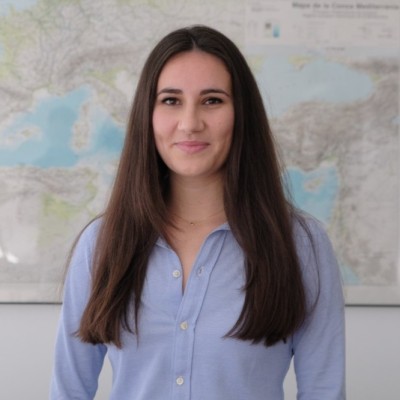
Paula Gomila Marqués is a policy adviser and project manager specialising in international security, counterterrorism, European affairs and geopolitics. She currently works with SAHER Europe, where she contributes to their research initiatives and implements several projects related to topics like disinformation, the protection of public spaces, defence and digital policy.
Paula has extensive experience managing and delivering European-level projects, and engaging with intelligence services, defence ministries, NATO, Europol, and the European Commission. Her work spans regulatory analysis (including the Digital Services Act, Terrorist Content Online Regulation, and AI Act), counterterrorism policy, online extremism, and risk analysis within the tech and security landscape
She holds a Master’s degree in International Security from the Institut Barcelona d’Estudis Internacionals and specialised training in Terrorism and Counterterrorism from Georgetown University.